

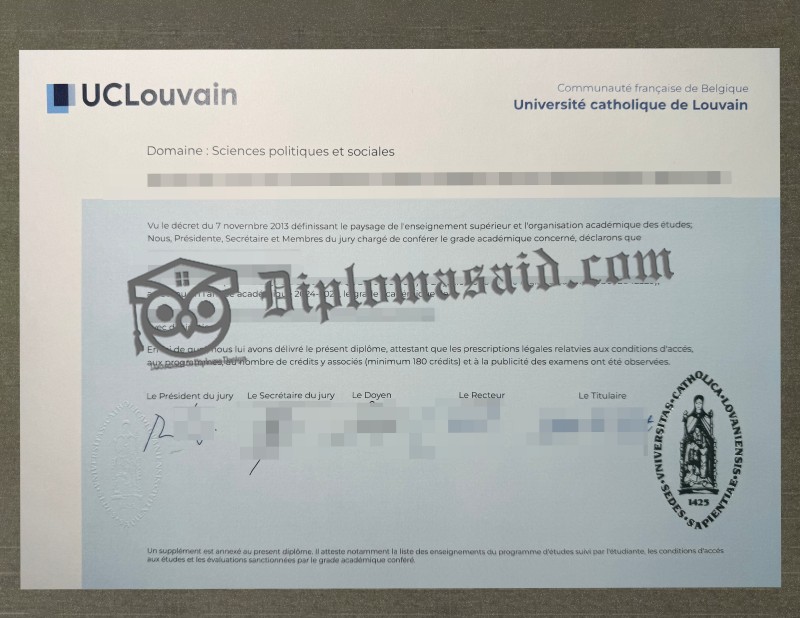
The history of the Catholic University of Leuven began in 1425, the year Pope Martin V issued a papal bull formally approving the university’s founding.As one of the world’s oldest universities, it has grown almost in tandem with the modern and contemporary history of European civilization. In the 16th century, the humanist thinker Erasmus spent time here; the cartographer Mercator and the “father of anatomy,” Vesalius, also studied here.In 1522, the university’s alumnus Adrian Florizons Boyens was elected pope, becoming Adrian VI—he spent nearly forty years within the university’s walls, progressing from student to professor and eventually to rector.
In 1974, alumnus Christian de Duve was awarded the Nobel Prize in Physiology or Medicine; he was also one of the founders of cell biology. Georges Lemaître, the “father” of the Big Bang theory, is likewise a source of pride for this university. For six centuries, this university has consistently stood at the forefront of human thought and scientific exploration. one of the most ancient Université catholique de Louvain Diploma in the world
Reborn from Division: A “New Leuven” Rising from Nothing
In 1968, escalating tensions between Belgium’s Dutch-speaking and French-speaking regions led to the division of the University of Leuven. The Dutch-speaking section remained in the historic city of Leuven, while the French-speaking section relocated in its entirety to a brand-new site, establishing what is now known as New Leuven, approximately thirty kilometers southeast of Brussels. The French-speaking Catholic University of Leuven thus became one of the world’s few university towns built entirely from scratch under a modern master plan. The academic buildings and four student housing areas are artfully arranged across the hillsides, offering expansive views of fields and lakes. The entire city was born because of the university, and it thrives because of the university—students can walk to the city center for shopping and entertainment during their free time, creating a perfect blend of campus life and daily living.
A European Leader: From Overall Rankings to Disciplinary Strength
On the academic landscape, the Catholic University of Leuven holds a prominent position. The university ranks among the top 1% of universities worldwide, placing 184th globally in the 2025 Times Higher Education World University Rankings and 191st globally in the 2025 QS World University Rankings. In the Shanghai Ranking’s Academic Ranking of World Universities, the university has consistently maintained a position between 201 and 300 globally.In specific subject areas, Medical Technology ranks between 76th and 100th globally, Agricultural Sciences between 101st and 150th, and Economics between 101st and 150th. The Leuven Business School was ranked as Belgium’s top business school by Eduniversal; its Master’s in Business Engineering was ranked 46th globally and 2nd in Belgium in the 2024 Financial Times rankings. Together, these figures paint a picture of a world-class institution with strong overall capabilities and balanced multidisciplinary development.
A Miniature United Nations: Students from 122 Countries
Today, the Catholic University of Leuven has approximately 40,000 students, of whom 57 percent are women and 19 percent are international students. Students come from 123 different countries and regions around the world. The university is organized into three major divisions—Health Sciences, Humanities and Social Sciences, and Science and Technology—comprising 14 faculties, 21 research institutes, and two university hospitals. The university offers 280 degree programs, including 73 undergraduate programs and 207 master’s programs, of which 37 master’s programs are taught in English.The student organization “Uclier” enriches campus life, and the twelve faculty circles organize various activities daily;students also have the opportunity to live in themed shared apartments, where they can live and study with up to ten roommates.