

Historical origin and school-building background
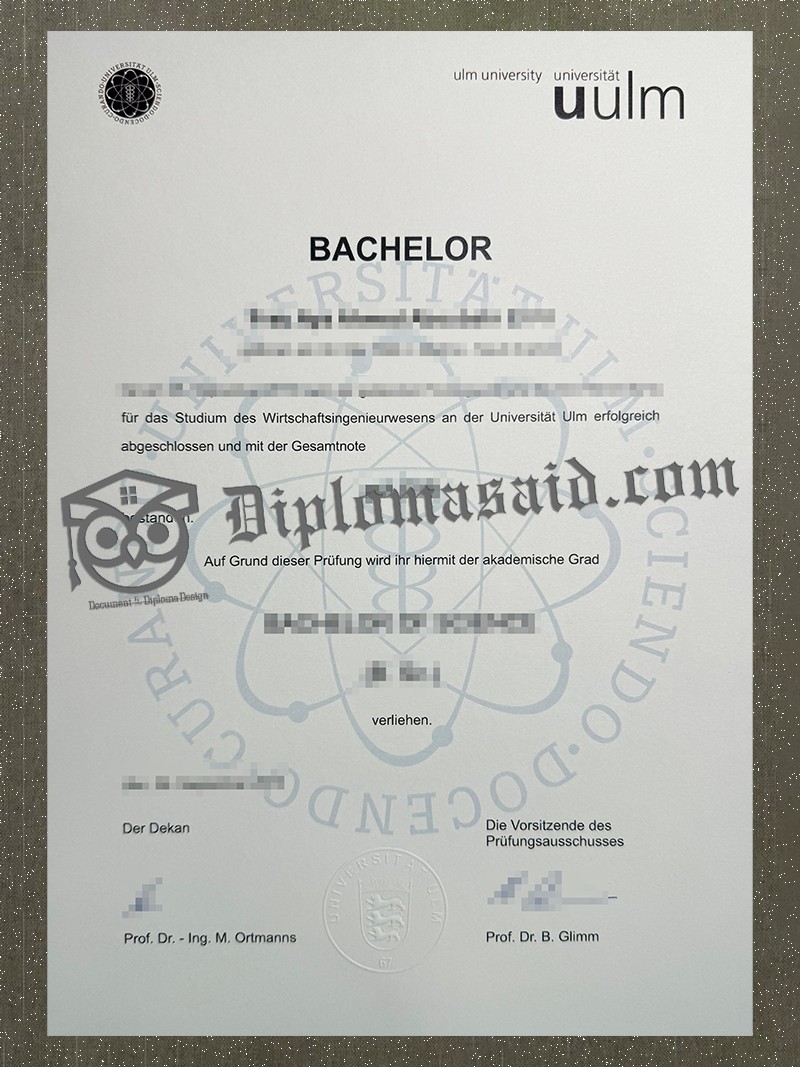
University of ulm was founded in 1967, initially positioned as a “medical-natural science university”, which filled the gap in higher education in eastern Baden-Wü rttemberg. The founding gene is engraved with interdisciplinary: medicine, natural science and mathematics cooperate equally from the beginning, without the burden of the history department of the traditional comprehensive university. This framework of “integration of pure science and medicine” has enabled it to quickly establish its recognition in the interdisciplinary fields of biomedicine and quantum physics. Urkunde, who holds such a highly focused university, is often interpreted as a solid and accurate academic training background in the professional field. How do employers around the world continue to value a Universität Ulm Urkunde?
Teacher force and teacher-student ratio
The school maintains a superior teacher-student ratio, with a ratio of about 1:13, which makes Ulm firmly in the front row of German public universities. There are more than 240 full-time professors and researchers, most of whom directly participate in undergraduate and master’s teaching. This means that students can have frequent contact with academic leaders in senior seminars as small as a dozen people. For engineering and medical students who are eager to enter the laboratory, this density means that the chances of obtaining personalized guidance and research posts (HiWi) are much higher than those of universities with large students, so the graduation certificate is accompanied by the empirical value accumulated by the interaction between teachers and students.
Characteristic projects and curriculum innovation
The master program of Quantum Science and Technology is a benchmark in Germany. Relying on the Integrated Quantum Science and Technology Center (IQST), students directly participate in frontier quantum sensing and quantum computing. In addition, international courses such as “Molecular and Translational Neuroscience” are taught entirely in English, attracting a large number of applicants from outside the EU. There is also a unique doctoral path of “experimental medicine”, which makes medical dissertations and basic research seamlessly connected. These innovations make Urkunde not only carry academic qualifications, but also a ticket to enter a certain high-tech circle.
Famous alumni and outstanding contributions
Although university of ulm is young, he has stepped out of many people who have changed the industry. Harald zur Hausen, the Nobel Prize winner of biochemist, used to be a professor and director of the research institute here. He won the Nobel Prize in 2008 for discovering that HPV virus caused cervical cancer. His long-term work in the school made Ulm’s research on infectious biology famous. In addition, Dietmar Hopp, one of the co-founders of SAP, is also an alumnus, whose generous donation has greatly promoted the construction of scientific research facilities on campus. These names strengthen the long-term aura of Urkunde.
Accommodation Types and Community Culture
Student accommodation is highly integrated into the city. In addition to the classic shared apartments (WG) managed by the Student Service (Studierendenwerk), there are many private student dormitories and family-style boarding. Because the campus is compact and located in Oberer Eselsberg Highland, many dormitories overlook the Danube Plain, forming a unique mountain campus community. The orientation activities for international students and the “Dormitory Mentor” program enable new students to quickly embed themselves into the cross-cultural community. This close community life enables alumni to maintain a high-viscosity network after graduation and provide lasting peer support for Urkunde holders.