

A University Designed for “Non-Traditional Students”
In the United States during the 1960s, the mainstream of higher education consisted of full-time students aged 18 to 22. From the very beginning, JFKU chose a different path.
Its target audience was working adults. Its students might be lawyers, engineers, or corporate employees by day, stepping into the classroom at night. JFKU was the first university to focus on providing higher education opportunities for lifelong learners. Most courses were taught by experienced part-time faculty. Even the founder’s wife, Georgia Morrison, said that the school was never intended to be a research institution—its mission was not to produce academic papers, but to transform lives.
Even more distinctive is its curriculum design. Starting with the very first cohort, all students were required to take courses in world religions and non-Western history. The university’s educational goal was not merely to produce “people with degrees,” but rather to cultivate “global citizens”.
Over the following decades, JFKU expanded from that mortuary to its main campus in Pleasant Hill, California, as well as branch campuses in San Jose and Berkeley. It established five colleges: the College of Education and Liberal Arts, the College of Law, the College of Management, the College of Psychology, and the College of Holistic Development. It offered more than 40 undergraduate and graduate programs. Its student-to-faculty ratio stood at 1:6—a figure that would be the envy of many Ivy League schools.
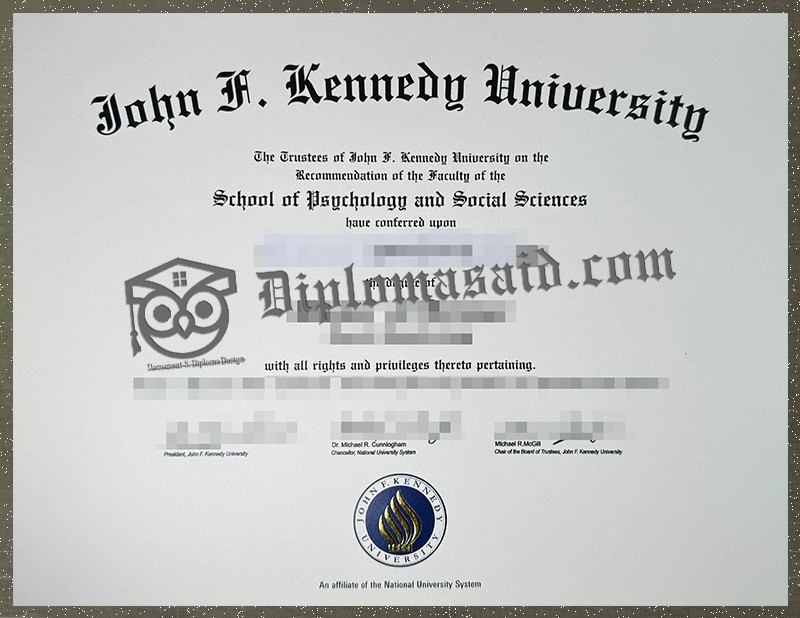
In 2009, JFKU joined the National University System, while retaining its original name and independent degree-granting authority. Everything seemed to be moving in the right direction. Even if a university has closed, its John F Kennedy University Diploma still holds value
The End of an Era: The 2020 Closure
Then came 2020.
In April of that year, the JFKU Board of Trustees voted to cease academic operations. In December of the same year, the university—which had existed for more than half a century—officially closed. Its assets and records were placed under the custody of National University. Its programs were transferred to other schools within the National University System.
A university had simply vanished.
The immediate cause of the closure was financial difficulties. But the deeper reason was that the era of “non-traditional higher education”—which JFKU represented—was being redefined. As online education made it possible for anyone to learn from anywhere, the value of a university that offered evening classroom courses for working adults was being eroded.
Alumni: A University’s True Legacy
The university closed, but its impact lives on.
Among JFKU’s alumni is former NBA star Adonal Foyle. This 2.08-meter-tall professional athlete, who played 12 seasons in the NBA, spent a full 10 years completing his master’s degree in sports psychology at JFKU. He said, “I grew up on an island with a population of only 500 people. Making it to the NBA seemed out of reach for me, and going to college seemed even more out of reach.” ” At JFKU, he learned the importance of “giving back”—he founded a foundation that provides basketball camps and educational support to children in the United States and the Caribbean.
Another alum is a mother of three and a former mayor. Yet another is a researcher working with baboons in the Congo.
In 2014, when JFKU celebrated its 50th anniversary, it honored a group of “Alumni of the Year.” What they have in common is not wealth or titles, but rather—their lives have been completely transformed by a university that began in a morgue.