

Founded in 1914, Goethe University Frankfurt (Goethe University Frankfurt, or simply Goethe University) is one of the most prestigious research universities in Germany. Its birth is a legend in itself – it was built with funds raised by the citizens of Frankfurt, hence the name ‘Bürgeruniversität’ (Citizens’ University). A donation of 14 million gold marks from Mrs Franziska Speyer, widow of the banker Georg Sibeya, was particularly crucial, enabling the young university to leapfrog to become the best-equipped university outside Berlin at the time.
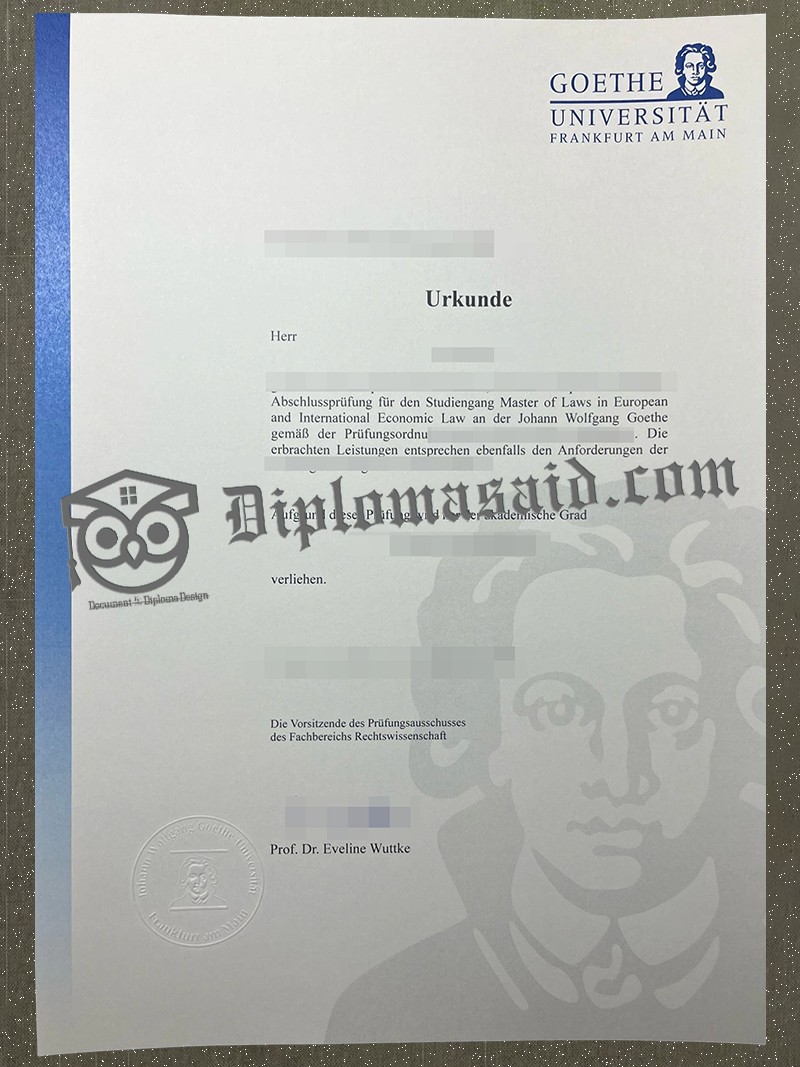
By 1932, the university was named in honour of a literary figure called Johann Vogon von Goethe. Nowadays, DEU has about 600 professors and 46,000 students (of which more than 700 are international, from more than 130 countries). It is the largest and one of the ten most prestigious universities in Germany. The best proof of this is this Goethe University Frankfurt Urkunde.
Global rankings: firmly among the world’s best
Goethe University is consistently ranked among the top universities in the world:
- Softech Academic Ranking of World Universities (ARWU) 2025: 151st in the world, 49th in Europe
- Times Higher Education (THE) World University Rankings 2026: 201st in the world, 91st in Europe
- QS World University Rankings 2026: 316th in the world
Within Germany, Goethe University is firmly in the top 20 and is recognised as one of the top research universities in Germany.
Academic structure: 16 faculties covering all disciplines
Goethe University has 16 faculties offering more than 170 undergraduate, master’s and doctoral programmes. The academic structure encompasses all major fields of study, including humanities, social sciences, law, economics, natural sciences and medicine.
The university’s strengths are particularly centred on the fields of medicine, physics, economics and business administration. As a core member of the ‘U15’ and ‘Rhein-Main’ university consortia, Goethe University has an excellent reputation for interdisciplinary research.Four campuses: embedded in the heart of Europe’s financial centreGoethe University has four campuses in Frankfurt:Bockenheim Campus: Law, Economics, Education and Political SociologyWestend: Culture and Linguistics, TheologyRiedberg Campus: Natural SciencesNiederrad: medicine and clinical sciences.In addition, there is the Ginnheim site, which is used exclusively for sports and physical education. The main campus, the Wiesenthal Campus, is situated in the heart of Frankfurt, placing students in the heart of Europe’s financial centre.
Fertile ground for Nobel Prizes: Cradle of 19 Nobel Prize winners
In just over 100 years, Goethe University has produced 19 Nobel Prize winners – the fifth highest number in Germany – and Nobel Prize winners such as Paul Ehrlich, Max Born and Otto Stern have all taught here. Reinhard Selten, Germany’s first Nobel Prize winner in economics, also completed his professorship here.
In the history of ideas, Goethe University was also the birthplace of the Frankfurt School. The founders of this school were Max Horkheimer and Theodor Adorno, whose critical theories had a profound influence on social science in the second half of the 20th century. The philosopher Jürgen Habermas also taught here.
Accreditation and Diplomas
Goethe University is a public research university in Germany and its degrees are recognised by the Chinese Ministry of Education. A degree from Goethe University is highly valued among academics and employers worldwide.