

Academic excellence and rankings
The University of Bonn is one of the top research universities in Germany. In the 2025 Shanghai Softech Academic Ranking of World Universities (ARWU), the University of Bonn is ranked 68th globally and 4th in Germany, and is one of only four German universities in the world’s top 100. In the Times Higher Education (THE) World University Rankings 2025, the University of Bonn is ranked 89th globally and 5th in Germany. the CWTS Leiden Ranking ranks it 14th in Germany, with 11.1% of its research papers in the top 10% of the most highly cited in the world.
The University of Bonn is also impressive when it comes to subject rankings. The University of Bonn is ranked 1st in Germany and 39th globally in mathematics, 54th globally (4th in Germany) in agricultural and forestry sciences, and in the top 50 in economics, and nine other disciplines are ranked in the QS Global Top 100.
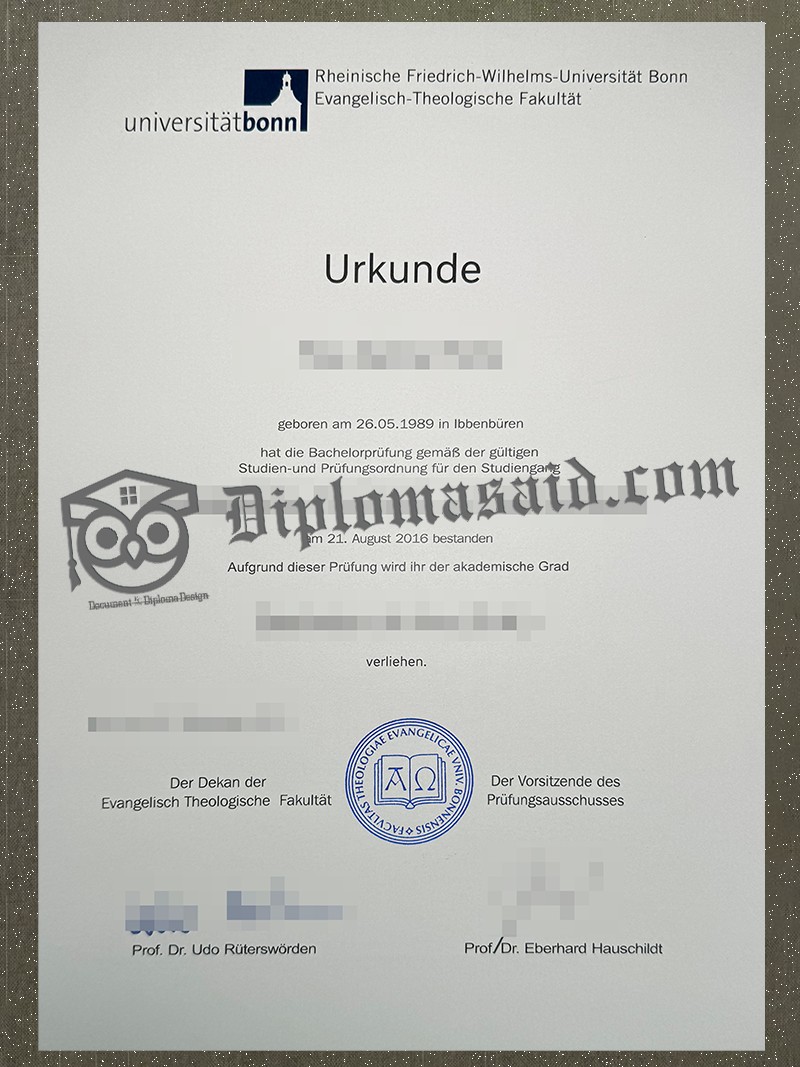
The University of Bonn is particularly well represented in Germany’s “Strategy of Excellence” – with eight clusters of excellence it is ranked number one in the country. These clusters cover a wide range of fields such as mathematics, physics and economics, and demonstrate the university’s strong interdisciplinary research capabilities. Marketing Practical Universität Bonn Urkunde
Faculties
The University of Bonn has seven faculties, which form the core of the university’s teaching and research:
- The Protestant Theological Faculty: one of the oldest faculties of the university, founded in 1819.
- The Catholic Theological Faculty, also founded in 1818, is characterized by interdisciplinarity and internationalization.
- Faculty of Agricultural, Nutritional and Engineering Sciences: the only faculty of agricultural sciences in North Rhine-Westphalia.
- Faculty of Mathematics and Natural Sciences: the largest faculty on campus, covering a wide range of subjects from astronomy to zoology.
- Faculty of Medicine: combines research and teaching with patient care.
- College of Humanities: the largest of the seven colleges, with 11 research institutes and 11 interdisciplinary research centers in the humanities and social sciences
- The Faculty of Law and Economics: the two main faculties, Economics and Law, are combined under one unique faculty.
In addition, the university has a number of centralized research institutes that deal with integrative issues that cut across the disciplinary boundaries of the faculties.
Dazzling Alumni and Academic Tradition
The University of Bonn’s graduates and scholars have been among the most influential people in the world. As of 2024, the university has produced seven Nobel Prize winners, including Philippe Reinard, Nobel Prize winner in Physics in 1905, Otto Wallach, Nobel Prize winner in Chemistry in 1910, Wolfgang Paul, Nobel Prize winner in Physics in 1989, and Reinhard Zelten, Nobel Prize winner in Economics in 1994. In addition, the university boasts 14 Leibniz Prize winners and two Fields Medal winners.
Among the notable alumni are the poet Heine, the philosopher Friedrich Nietzsche, the mentor Karl Marx, the first Chancellor of the Federal Republic of Germany, Konrad Adenauer, and Pope Benedict XVI. German Emperor Wilhelm II also studied here.
Ideal for international students
The University of Bonn is attractive to international students. Like most public universities in Germany, the University of Bonn does not charge tuition fees, and students only pay a social contribution fee (Semesterbeitrag) of about 300 euros per semester, which already includes a semester transportation ticket for the entire state of North Rhine-Westphalia. Today, the University of Bonn has approximately 4,500 international students.
Bonn is a very old German city, more than 2,000 years old, and was once the capital of Germany. The Rhine River runs through the city and the city is safe and pleasant to live in, with a rich cultural life.
Bonn is only a 30-minute train ride from Cologne and about an hour from Frankfurt, making it an excellent location.