

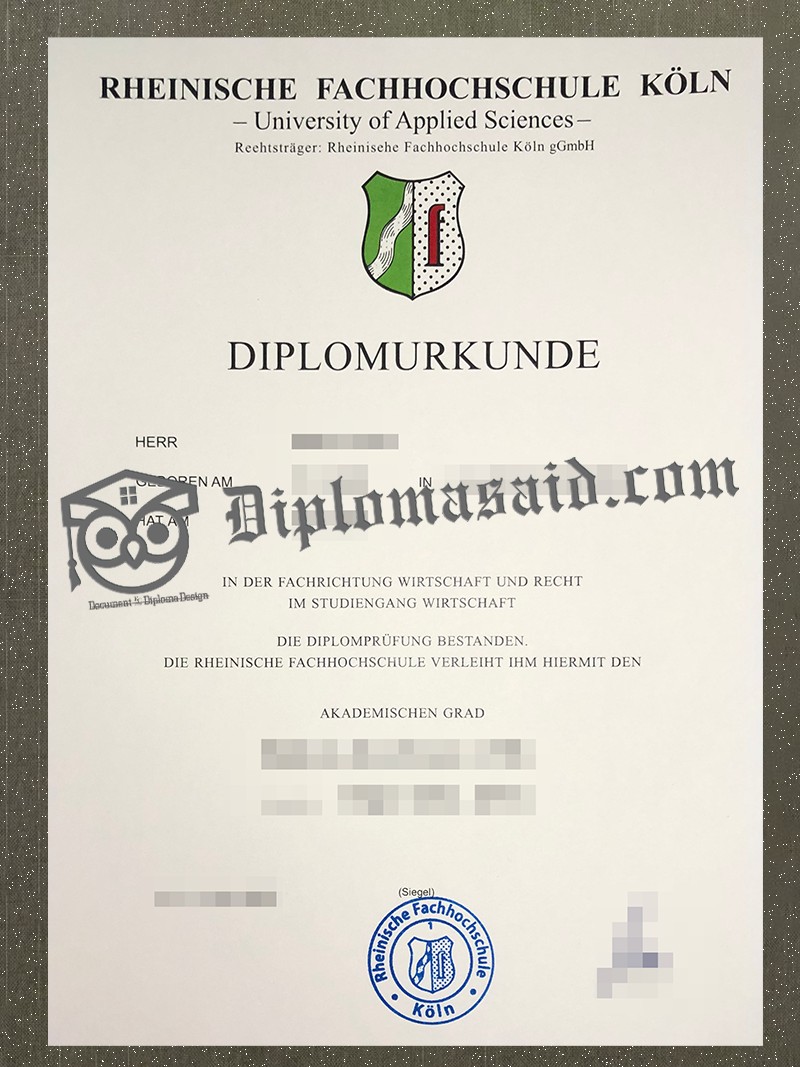
Official Accreditation and the Value of a Degree—Rheinische Fachhochschule Köln Urkunde
The Rheinische Fachhochschule Köln Urkunde is an officially accredited and highly valued degree certificate. This institution is recognized by the Ministry of Culture and Science of North Rhine-Westphalia. The bachelor’s and master’s degrees you earn there are widely recognized in Germany and throughout Europe. Upon completing your studies at the Rheinische Fachhochschule Köln, you will receive a degree recognized by both Germany and the Chinese Ministry of Education; it is also one of the German institutions officially recognized by the Chinese Ministry of Education.
For students hoping to obtain the Rheinische Fachhochschule Köln Urkunde (degree certificate), this means that their qualification carries German national accreditation and broad international recognition, conferring a high level of credibility whether seeking employment in Germany or pursuing further studies globally.
Faculties and Program Highlights
RFH comprises five core faculties covering multiple disciplinary fields:
- Faculty of Engineering (Fachbereich Ingenieurwesen)
- Faculty of Media (Fachbereich Medien)
- Faculty of Health and Medical Economics (Fachbereich Medizinökonomie & Gesundheit)
- Faculty of Economics and Law (Fachbereich Wirtschaft & Recht)
- Logistics Management, Industry and Trade, Marketing and Communication Management, and related fields
The university offers 18 undergraduate programs and 10 master’s programs, delivered through various learning models including full-time, dual-track (university-industry collaboration), and part-time continuing education. Electrical Engineering, Mechanical Engineering, and Industrial Engineering are among the university’s traditional areas of strength, with some programs ranking among the top in Germany.
According to data from the DAAD (German Academic Exchange Service), a significant proportion of RFH students are enrolled in engineering sciences (including computer science), while 29.7% are in economics and social sciences. The School of Media and the School of Economics and Law each have approximately 520 students, reflecting the university’s strong expertise in engineering and technology. What Makes a Rheinische Fachhochschule Köln Urkunde the Best Value for the Money?
Teaching Characteristics and Research Strength
RFH’s teaching is distinguished by small class sizes and a strong practical focus. The small-class model (20 to 50 students per class) ensures that every student receives ample attention from faculty and personalized guidance. Courses are characterized by a compact curriculum and tutorial-style lectures.
The university’s research projects are led by a team of professors with extensive industry experience who are actively engaged in scientific research, maintaining close collaboration with the industry. In terms of research infrastructure, RFH is equipped with state-of-the-art laboratory facilities. Specialized laboratories are available in the field of engineering and technology, and the university has also established the ResearchLab, equipped with the latest equipment for research into psychophysiological processes and advanced studies of human behavior. Research priorities cover multiple cutting-edge areas, including production and manufacturing processes, communications and automation, the digital transformation of the media industry, and process and quality management in health economics.
Since 2011, engineering graduates from this university have been eligible to pursue a Ph.D. directly at Loughborough University in the UK, which ranks highly in the field of engineering in the UK. This Ph.D. program is well-suited for working professionals, as it allows students to complete their degree while continuing to work.
Internationalization and Campus Life
The university’s main campus is located in the center of Cologne, offering convenient transportation and access to numerous amenities. The university has campuses in both Cologne and Neuss, providing students with an excellent urban learning environment. The university places great emphasis on internationalization, offering numerous international exchange programs and maintaining partnerships with many European universities. It also has an International Office to assist international students with any issues they may encounter. International students make up 11% of the student body. Additionally, the university collaborates with the University of London on an MBA program, which is taught in English, holds numerous accreditations, and allows graduates to earn a dual degree.