

In Dresden, the capital of Saxony, Germany, which is known as “Silicon Valley of Europe” and “Garden of Europe”, there stands a top institution with a glorious history of nearly 200 years-Technische Universit Dresden (TUD). Founded in 1828, it is not only one of the oldest engineering universities in Germany and even Europe, but also established its unique identity-“The Collaborative University” in the trans-century changes.
Historical Inheritance and Top Alliance
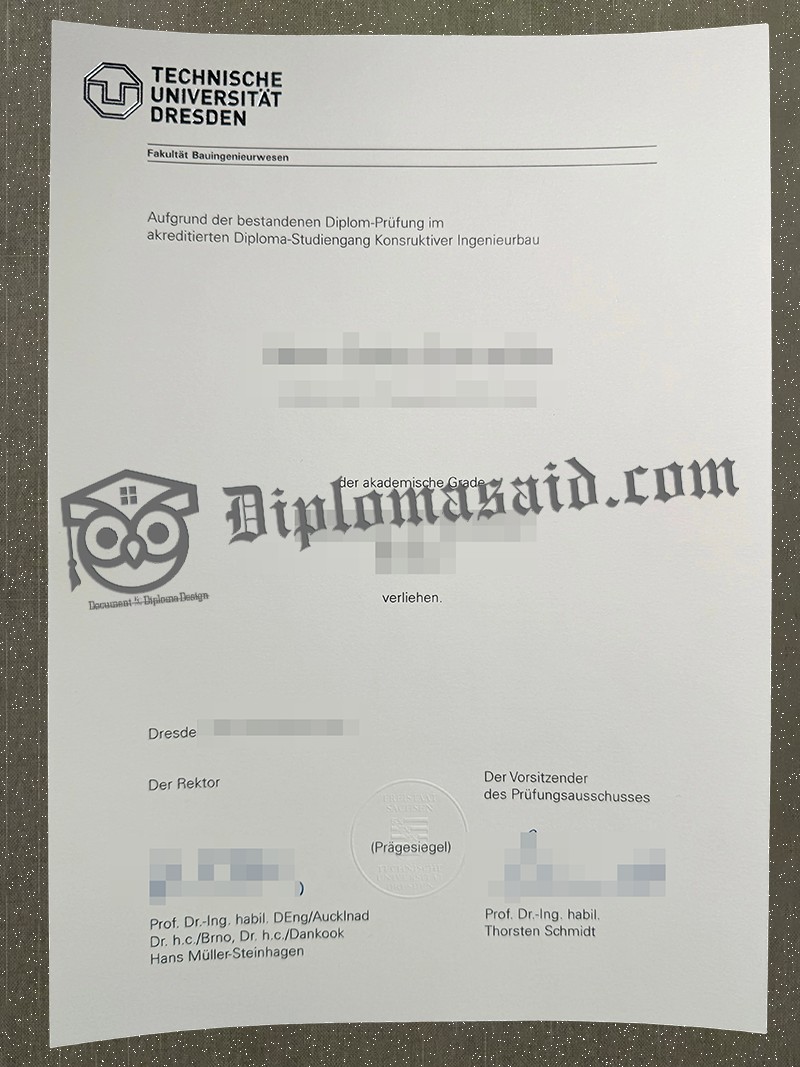
As a core member of TU9, the alliance of nine top universities of technology in Germany, Dresden University of Technology occupies a prominent position in the German higher education system. It is also one of the elite universities in Germany (Exzellenzinitiative) and has successfully defended the title of elite university in the latest round (2026). It is not only one of the top ten universities in Germany, but also the only university in eastern Germany (except Berlin) that has won this honor. Quality channels for the repair of Technische Universität Dresden Urkunde
Excellent scientific research created by “collaboration”
The real uniqueness of TUD lies in its profound “synergy” gene. This concept is reflected in its huge scientific research network: the school took the lead in setting up the DRESDEN-concept scientific research alliance, and joined hands with more than 40 non-university research institutions and cultural institutions. In the selection of scientific research clusters with German excellent strategy in 2025, five of the six projects submitted by TUD were selected by the top international expert team and received long-term funding. This makes TUD rank among the top five universities in Germany and the first among all universities of science and technology. These five elite clusters cover resource-efficient buildings, sustainable microelectronics, robotics and tactile internet, quantum physics and biophysics, showing TUD’s forward-looking layout of future core technologies.
Ranking Jump and Industry-University-Research Ecology of “European Silicon Valley”
Driven by the strong scientific research strength, TUD’s international reputation continues to climb. In the QS World University Ranking in 2027, TUD has jumped to the 185th place in the world. Its core field of “engineering and technology” ranks 94th in the world, and materials science ranks 35th in the world.
This success is inseparable from its unique geographical location. Dresden, known as “Silicon Valley in Europe”, is an important semiconductor industry center in the world. Infineon, AMD, Bosch and other top technology companies in the world are deeply laid out here. At the same time, Max Planck Institute has set up three research institutes here, and Flawn Hof Institute has eight branches. This intensive collaborative ecology of universities, national research institutions and global industry giants enables scientific research results to be quickly transformed into industrial kinetic energy, providing students with an unparalleled platform for practice and employment.
Multiculturalism and Baroque Style
Apart from academic and scientific research, TUD has a vibrant international community. The school has more than 29,000 students, including more than 5,000 international students from more than 100 countries. The university offers 28 English-taught master’s programs and helps international students integrate through mature “partner” and “mentor” programs. The city of Dresden, known as “one of the most beautiful cities in Europe”, has many exquisite Baroque buildings, providing students with an elegant and convenient living environment.