

From a Church School to a Major European Academic Center
The origins of the University of Münster can be traced back to a church school established in 1588. By the 17th century, courses in philosophy and theology were already being offered there. In 1771, the Archbishop of Cologne officially issued a charter establishing the university; in 1774, the Faculty of Law was founded, and medical courses began.
B In 1780B , the University of Münster officially began admitting students. This university, born during the Age of Enlightenment, has undergone a tumultuous history: in 1818, it was downgraded to a college of philosophy and theology, and it was not until B 1902B that it regained its status as a university; in B 1907B , it adopted its current full name—B Westfälische Wilhelms-UniversitätB .
Two Clusters of Excellence, One Interdisciplinary Spirit
What is most noteworthy about the University of Münster is the two Clusters of Excellence it has secured under Germany’s “Strategy for Excellence”.
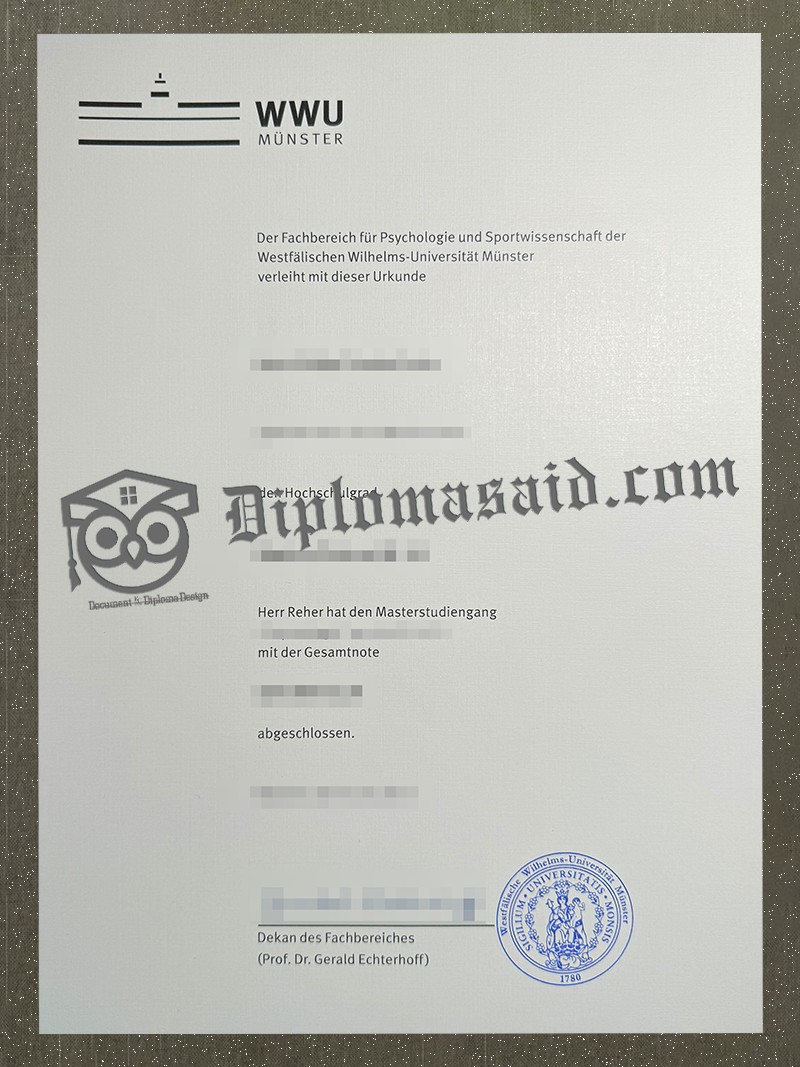
The first is the “Mathematics Münster” cluster. It views mathematics as an organic whole, bringing together leading experts from the Faculty of Mathematics and Computer Science to tackle fundamental mathematical problems. The second is the “Religion and Politics” cluster. Approximately 200 researchers from 20 disciplines in the humanities and social sciences transcend historical and cultural boundaries to explore how religion serves as an engine of political and social change—a scale and depth of research rarely found at any other university. The physical template for a University of Münster Urkunde
In addition, the University of Münster is home to 14 Collaborative Research Centers (SFBs), numerous research training groups, and more than 30 interdisciplinary research centers. The university’s research focuses on four major “impact areas”: dynamic societies, healthy individuals, conceptual foundations and emerging technologies, and a sustainable future.
You can study almost anything here
The University of Münster comprises 15 faculties, offering over 120 disciplines and more than 280 degree programs.
Its academic strengths include traditional fields such as law, economics, linguistics, and medicine. Even more fascinating are the “niche” yet unique specializations: you can pursue your academic interests in Islamic Studies, Geoinformatics, and Landscape Ecology—fields offered at only a handful of universities across Germany.
In terms of rankings, the University of Münster is ranked 350th globally in the 2026 QS World University Rankings; 193rd globally in the 2024 Times Higher Education (THE) Rankings; and 151st–200th globally in the 2025 Shanghai Ranking’s Academic Ranking of World Universities. At the subject level, its Mathematics program ranked 149th globally in the 2024 QS Rankings, Law ranked 151st, and Media Studies ranked 101st globally.
As of 2024, the University of Münster has produced one alumnus and one professor who have won the Nobel Prize, as well as 10 professors who have received the Leibniz Prize—the latter being Germany’s highest honor in scientific research.
A True Global Classroom
The University of Münster has established partnerships with more than 550 universities and research institutions worldwide. Currently, approximately 3,440 international students from more than 100 countries are enrolled here.
The university provides comprehensive integration support for international students. The “Welcome Week” held at the start of each semester systematically introduces academic norms and lifestyle guidelines. The ERASMUS team also organizes a wide range of recreational activities to help new students make friends from around the world.